Custom software & AI for European operators
Same business. Same revenue.
Two very different Tuesdays.
One of these owners runs a €1M+ company on a generic business suite, three side spreadsheets and a CRM nobody opens. The other runs the same company on a system built around how the business actually works. The difference was never ambition. It was infrastructure.
Free · 45 minutes · you leave with a written system map

An uncomfortably specific list
If two or three of these sting, we should probably talk.
Every line below came from a real conversation with a profitable European business. None of them had a software problem. All of them had an operations problem wearing a software costume.
How it runs today
- A €4M business running on a generic suite, plus the spreadsheet the team actually trusts.
- A CRM you pay for monthly, opened annually, configured by someone who left.
- Seven tools, none of which speak to each other, all of which send invoices.
- Quotes rebuilt from scratch every time, because the last one lives in someone's inbox.
- "Did anyone follow up with them?" — asked weekly, answered never.
- Month-end closed by copy-paste, faith, and a late evening.
How it runs after
- One system that holds the truth, and no single person who has to remember it.
- Software your team opens because it is faster than the workaround.
- Tools connected once, so the data arrives before you ask for it.
- Quotes and orders generated in seconds from what you already know.
- Follow-ups that happen whether or not anyone remembered.
- Numbers ready on the first, without a single heroic evening.
Nothing here requires a transformation programme, a change consultant, or a new operating philosophy. It requires software that matches how your business already works.
What is actually going on
You did not build a mess. You bought one, subscription by subscription.
You are not disorganised. Your tools are.
Nobody chose this stack. It accumulated — one urgent subscription at a time, each solving a problem in isolation and creating two more between the gaps.
Off-the-shelf software makes you work its way.
So you bend the business to the software, then hire people to manage the bending. That headcount is the licence fee nobody puts on the invoice.
The bottleneck is usually you.
If the decisions, the pricing logic and the exceptions all live in your head, the business cannot run without you in the room. That is not a business, it is a job with more risk.
Custom vs off-the-shelf
Most of our clients already pay for business software. That is the problem.
Platforms such as Zoho, Odoo, Monday and similar suites are well-built products — they are simply designed for a general market, not for your specific operation. Understanding them, configuring them, and then quietly reshaping your processes around them is real work, paid for in your team's time. This is the trade-off, side by side.
Who adapts
Your processes are reshaped to fit the platform's model of how a business should work.
The software is shaped around the process your team already runs well.
Onboarding effort
Modules, fields, pipelines and permissions to learn and configure before anyone gets value.
Your own vocabulary and screens, so the team recognises the workflow on day one.
The edge cases
The 10% that makes your business distinctive usually ends up in a side spreadsheet or a manual step.
The exceptions are modelled in the system, because they are why customers choose you.
Change later
Changes are limited to what the roadmap and configuration layer permit, sometimes via a partner.
Change requests are scoped against your business case, not a vendor release cycle.
Cost shape
Lower to start, then per-seat and per-module fees that grow as the team grows.
Higher upfront build, then hosting and the changes you choose to make. No seat tax.
Integration
Strong inside its own ecosystem; connecting outside tools often needs middleware.
Built directly against the suppliers, marketplaces and accounting tools you actually use.
Data & ownership
Your data lives in the vendor's schema, exportable but shaped by their product.
You own the code, the database and the hosting. Nothing is held hostage.
Where AI applies
Generic assistants across generic objects, added at the vendor's pace.
AI applied to your documents, pricing rules and follow-ups, where it removes real work.
Honest fit
Genuinely the right answer for standard, low-complexity operations — and we will say so.
Worth it when operational complexity is the thing limiting the business.
Comparison reflects our own experience migrating client operations and describes general product design trade-offs, not defects. Zoho, Odoo and Monday.com are trademarks of their respective owners; Atomberg is not affiliated with, endorsed by, or a partner of any of them. Features and pricing models change — check each vendor for current details.
ROI calculator
What manual admin is costing you this year.
Estimate the recoverable time in your operation, then see how quickly a custom system pays for itself. Adjust the numbers to match your team.
This is a planning estimate based on your inputs, not a promise of results. We give a measured before/after figure on the workflow we actually rebuild.
System scope
Recoverable / month
€2,300
Recoverable / year
€28,100
Payback
2.6 months
18 hours a week currently goes into work a system can do. That is roughly 78 hours a month of your team's capacity.
The actual product
We do not sell software. We sell the Tuesday where nobody needs you.
Better systems are not a technology purchase, they are a freedom purchase. Fewer evenings reconciling numbers. Fewer decisions that only you can make. A business that keeps its promises whether or not you are watching it.
That is also, conveniently, how businesses become worth more: documented processes, clean data, and operations that do not depend on the founder's memory.
The hours back
Admin that used to take a day, done while you read this.
The decisions back
Rules in the system, not in your head or Marta's.
The evenings back
Month-end that closes itself, on the first.
Client work
Two European businesses that stopped bending their operations to software.
We work with a small number of operators at a time. These are the real interfaces their teams use every day — no unnamed logos, no invented metrics.
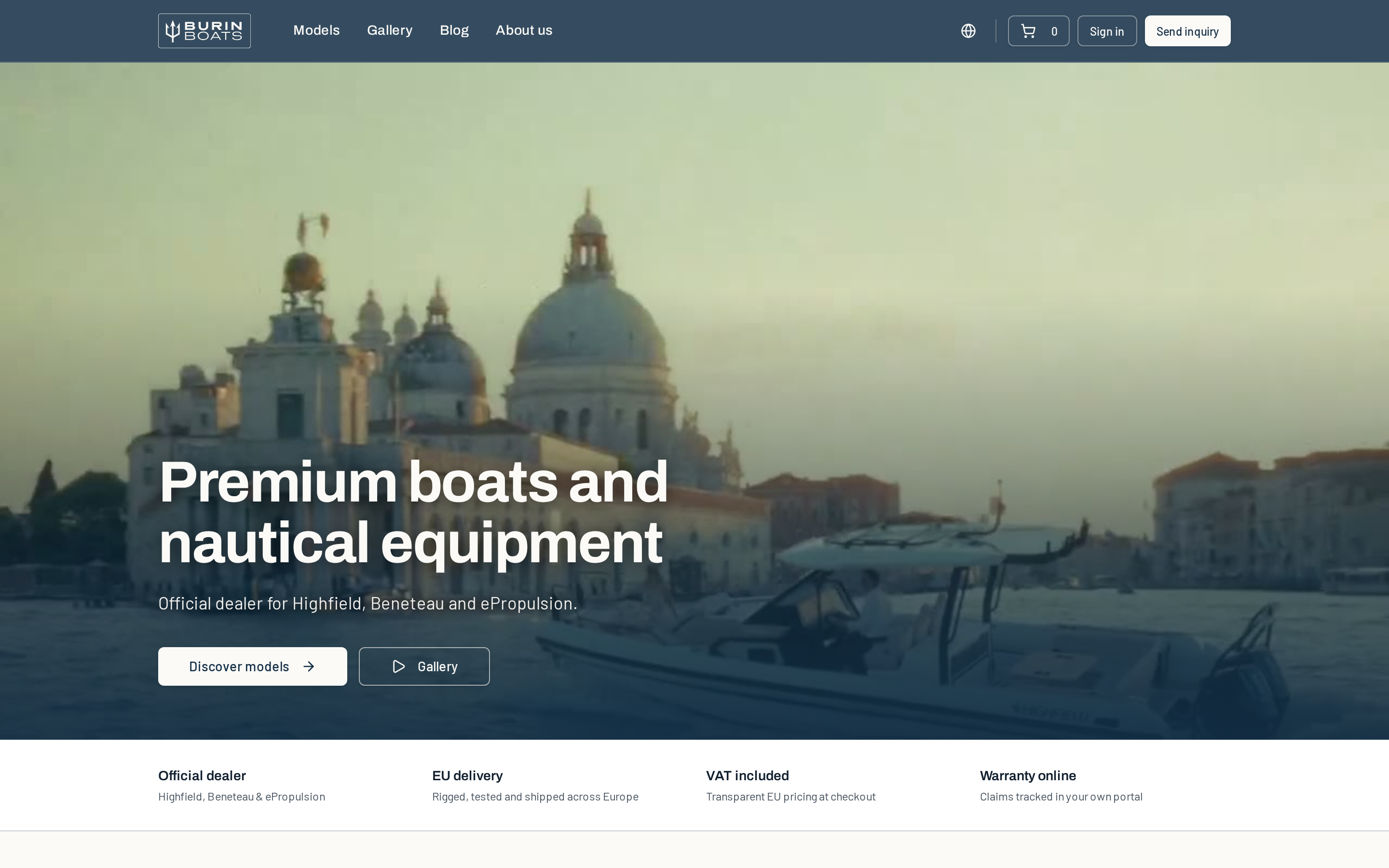
Marine retail
Burin Boats
High-value marine sales running on a storefront that actually knows what is in stock.
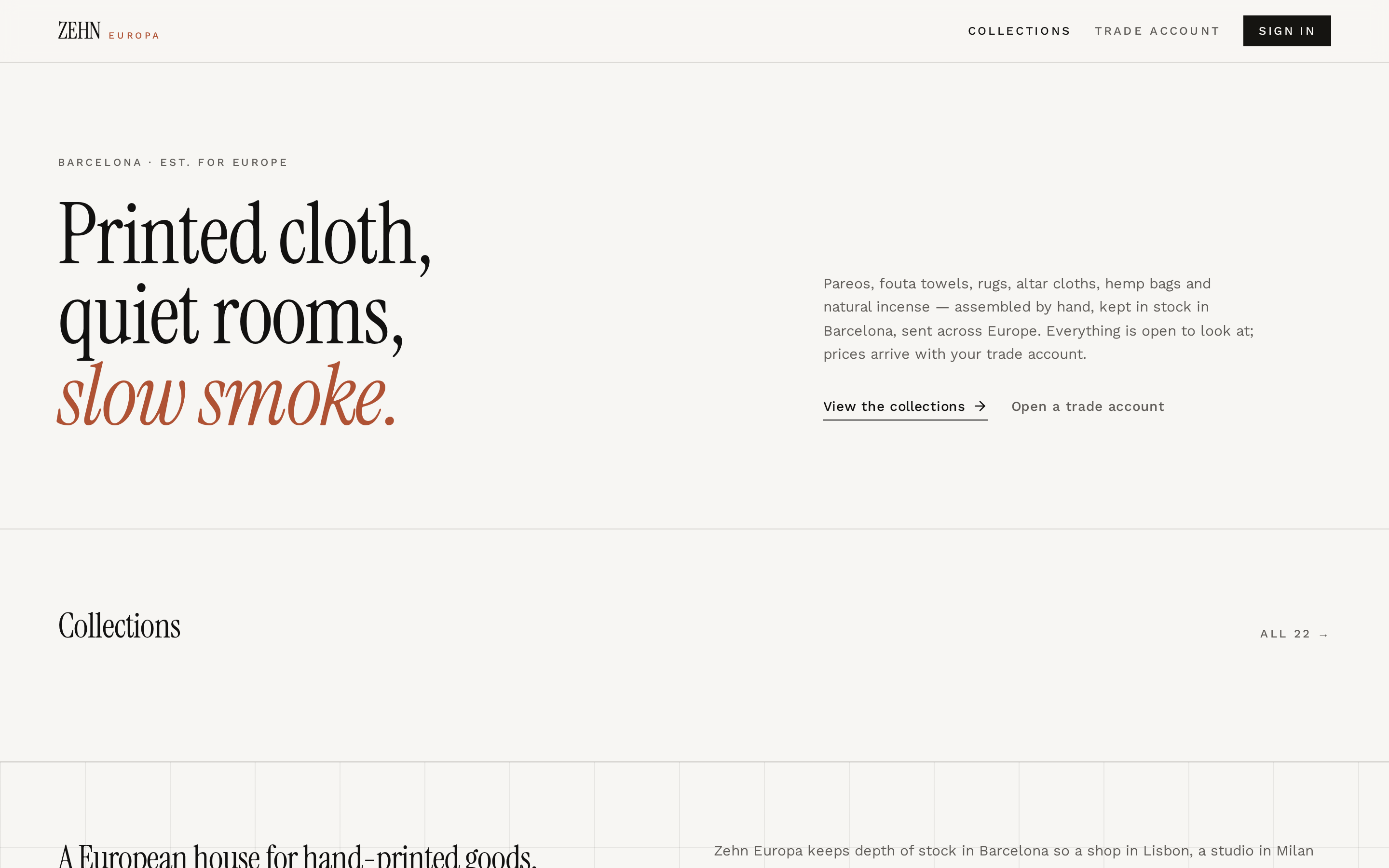
Textile & handloom wholesale
Zehn Europe
Wholesale operations pulled out of spreadsheets and rebuilt as one internal system.
How it works
Four steps, no transformation programme.
We start with the process, not the platform. Nothing gets built until we agree which workflow is costing you the most.
Step 01
We map the mess
45 minutes, no deck. We follow one process end to end and write down every hand-off, re-typed field and "we just know to do that" rule. You keep the map either way.
Step 02
We fix the worst workflow first
A fixed-scope pilot from €1,000. One painful workflow, live in weeks, measured against the hours it used to eat.
Step 03
We build the system around it
Quoting, orders, inventory, follow-up, reporting — connected, owned by you, with AI only where it removes real work rather than adding a chatbot.
Step 04
You get your week back
The measure of success is not features shipped. It is how long the business runs correctly while you are somewhere with no signal.
Who you work with
Founder-led, operator-built.
Jitesh
Founder, Atomberg
Atomberg is founder-led. Every engagement is scoped, architected, and reviewed by the person who has run operations, not by a sales team.
I spent years running and building businesses where the bottleneck was never ambition — it was admin. Orders in spreadsheets, stock nobody trusted, quotes rewritten by hand, and a team spending its best hours re-entering data.
Atomberg exists because AI has made it realistic to fix that with software built for one business, at a price that used to only buy a template. I map the process first, remove the steps that should not exist, and only then build.
Operating background
- Multi-location operations and inventory-heavy retail
- Wholesale and distribution workflows across Europe
- Hospitality and service businesses with high enquiry volume
- Direct-to-consumer commerce and fulfilment
FAQ
The questions owners ask before they trust anyone with their operations
Straight answers on price, payback and how engagements run. More on the FAQ page.
- What does Atomberg do?
- Atomberg is a software and AI studio that builds custom business systems for established European companies. Work includes custom operational software, AI automation, e-commerce and revenue systems, systems integration, and long-term technology partnership where Atomberg acts as a company's external technology department.
- Who does Atomberg work with?
- Atomberg works with owner-led and mid-sized European businesses that already have revenue and operational complexity — manufacturing and marine, wholesale and distribution, hospitality, textiles, and services. Most already run a generic business suite such as Zoho, Odoo or Monday alongside spreadsheets, and are replacing that patchwork with one system that reflects how they actually operate.
- What kind of results has Atomberg delivered?
- For Burin Boats, Atomberg built the storefront and operational layer for a boat business at burinboats.shop. For Zehn Europe, a wholesaler of textile and handloom goods, Atomberg built custom internal software and optimised internal operations across ordering, inventory, and fulfilment.
- How much does Atomberg charge?
- A fixed-scope Operations Pilot — one workflow mapped, built, and live — starts at EUR 1,000 and takes two to four weeks. A Core System, the operational platform a business runs on, starts at EUR 6,000 and is delivered in phases over six to twelve weeks. Ongoing Technology Partnership starts at EUR 600 per month on a rolling basis with a three-month minimum. Final pricing depends on project size and scope. All work is quoted and invoiced in EUR; other currencies shown on the site are indicative conversions.
- Why is custom software affordable now when it was not before?
- AI-assisted engineering removes most of the manual production cost of software: scaffolding, boilerplate, integrations, tests, and iteration. Work that previously needed a team for months is now weeks of focused effort, so a bespoke system built for one business now costs what off-the-shelf implementation projects used to cost.
- What is a systems review?
- A free 45-minute session where Atomberg maps the business process end to end, identifies which workflow is costing the most in time and errors, and states what fixing it would involve and cost. The written system map belongs to the business whether or not it engages Atomberg.
More questions, plus articles on moving off generic suites, where AI actually helps, and buy-versus-build decisions.
Client enquiry
Bring the mess. We will map it in 45 minutes.
No specification required, no deck, no obligation. Describe the process that annoys you most and we will tell you what fixing it looks like — including if the honest answer is that you do not need us yet.